



 English
 Arabic
 Chinese (Simplified)
 French
 German
 Japanese
 Korean
 Russian
 Spanish
 Swedish
Yes, some people do take naltrexone at night for weight loss — but whether that works well depends on how your body reacts to it.
There’s no single “best” time that works for everyone. Nighttime dosing may help with late-night cravings for some, while others feel better taking it earlier in the day.
That’s the simple answer.
Now here’s where it gets interesting.
Why People Even Ask About Taking It at Night
Weight loss struggles don’t always happen during meals.
They often happen after dinner.
Late-night snacking.
Mindless eating.
Cravings that show up when the day finally slows down.
That’s why so many people wonder if taking naltrexone at night might help quiet those urges.
And honestly, it’s not a silly question.
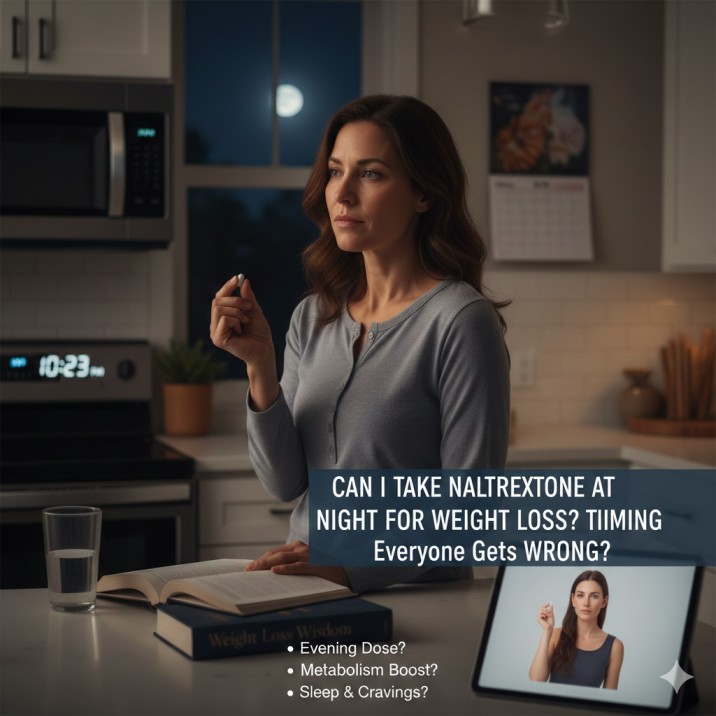
What Naltrexone Does (In Plain Language)
Naltrexone doesn’t burn fat.
It doesn’t magically speed up metabolism.
What it does affect is the brain.
Naltrexone works on reward pathways that influence:
Cravings
Emotional eating
Compulsive food behaviors
That’s why it’s sometimes discussed in weight-management conversations — especially when food feels hard to control.
Timing matters because cravings don’t follow a schedule.
Why Nighttime Use Sounds Appealing
For a lot of people, nighttime is the danger zone.
That’s when:
Willpower is low
Stress catches up
Comfort eating feels automatic
Taking naltrexone at night may help reduce that urge for some individuals. The idea is simple: if cravings peak late, timing the support closer to that window can make sense.
But — and this is important — it doesn’t work the same way for everyone.
How the Body Can React at Night
This is where personal response comes in.
Some people report that nighttime use:
Helps curb evening snacking
Makes food feel less tempting
Supports better portion control
Others notice:
Trouble sleeping
Vivid dreams
Feeling wired or restless
That doesn’t mean anything is “wrong.”
It just means the body responds differently.
Sleep and Naltrexone: What to Consider
Sleep quality matters for weight loss more than most people realize.
Poor sleep can:
Increase hunger hormones
Reduce energy levels
Make cravings worse the next day
If nighttime naltrexone interferes with sleep, it may indirectly work against weight-loss goals — even if cravings feel lower.
That’s why timing isn’t just about appetite.
It’s also about rest.
Why Some People Prefer Earlier Timing Instead
For others, taking naltrexone earlier in the day feels smoother.
Possible reasons include:
Fewer sleep disturbances
More stable energy levels
Appetite control throughout the day
Weight loss isn’t just about nighttime behavior. It’s about total daily patterns.
For some, daytime support works better overall.
There’s No “Correct” Time — Only the Right Fit
This is the part that frustrates people.
They want a rule.
Morning or night?
Yes or no?
But weight management rarely works like that.
The ideal timing depends on:
When cravings are strongest
How sensitive someone is to medications
Sleep patterns
Daily routine
That’s why timing decisions are usually adjusted, not fixed forever.
Can Nighttime Use Help With Emotional Eating?
Sometimes, yes.
If emotional eating mostly happens at night — after stress, boredom, or exhaustion — nighttime support may help reduce that behavior.
But emotional eating isn’t purely chemical.
Long-term success usually comes from combining:
Awareness
Routine
Better sleep
Stress management
Medication can help — it just isn’t the whole picture.
Weight Loss Expectations (Let’s Be Real)
Naltrexone alone doesn’t guarantee weight loss.
Results depend on:
Consistency
Eating habits
Activity level
Sleep and stress
Timing can influence comfort and adherence, but it won’t override lifestyle patterns by itself.
That’s why expectations matter.
The Mistake People Often Make
Trying to copy someone else’s schedule.
What works for one person might feel awful for another.
Weight loss support should fit into real life — not disrupt it.
If timing causes poor sleep or discomfort, it usually needs adjusting rather than forcing.
Is Nighttime Use “Better” for Weight Loss?
Not automatically.
It can help some people with:
Evening cravings
Late snacking habits
But it can be less helpful for those who:
Are sensitive to sleep changes
Already struggle with insomnia
Feel restless at night
The best timing is the one that supports both appetite control and good sleep.
Final Thoughts
So, can you take naltrexone at night for weight loss?
Yes — some people do.
But it’s not a universal solution.
The goal isn’t following a perfect schedule.
It’s finding a rhythm that helps control cravings without hurting sleep or daily energy.
Weight loss works best when support tools fit naturally into your routine — not when they fight against it.
FAQs (People Commonly Ask)
Can taking naltrexone at night help stop late-night snacking?
For some people, yes — especially if cravings peak in the evening.
Does nighttime use affect sleep?
It can. Some experience vivid dreams or restlessness, while others sleep fine.
Is it better to take naltrexone in the morning or at night?
Neither is universally better. Timing depends on personal response and lifestyle.
Will nighttime dosing lead to faster weight loss?
Timing alone doesn’t determine results. Consistency and habits matter more.
Can timing be adjusted over time?
Yes. Many people adjust timing based on how they feel and respond.
6 Comment(s)
A few years ago, I had a very similar experience that fundamentally altered my perspective on the subject. This brought back a lot of memories. It's comforting to know that others have experienced similar things.
I really appreciate you sharing this; I've been searching for a well-written perspective on this topic for a long time, and you did a great job. I particularly enjoyed the section where you discussed the typical errors people make. I will unquestionably suggest this to everyone I know.
Nice answers in return of this issue with genuine arguments and explaining all on the topic of that.
My go-to source for trustworthy information on this topic is now your blog. This post in particular caught my attention because you covered the subject in great detail without making it seem overly lengthy. I particularly appreciated the part where you talked about the typical misunderstandings. I'll make sure to read your other posts as well.
It was just what I needed to read today - this blog post. The useful guidance and useful insights you offered are really valuable. I'm already considering how I might use some of these concepts in my personal life.
I've recently read a few posts about this topic, but yours caught my attention due to its uniqueness and clarity. You broke down complex ideas without oversimplifying them, which is a tough balance to strike. I'm going to bookmark this for later!
Leave a Comment