


 English
 Arabic
 Chinese (Simplified)
 French
 German
 Japanese
 Korean
 Russian
 Spanish
 Swedish
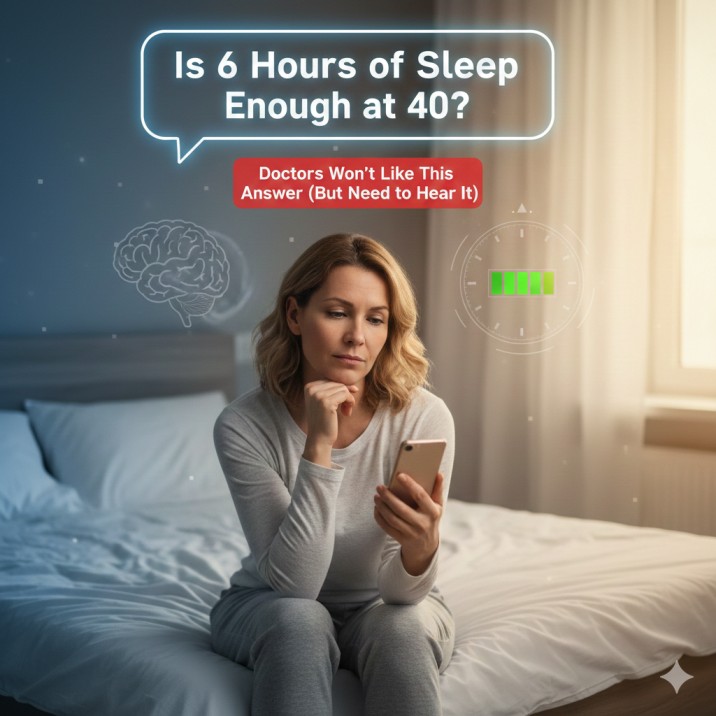
While you can survive on 6 hours, research and real-world health patterns show that adults around 40 usually need 7 to 9 hours to stay mentally sharp, hormonally balanced, and physically healthy.
That said…
There are exceptions. And the real answer is more nuanced than a simple yes or no.
Let’s break it down.
Why This Question Hits Different After 40
In your 20s, you could pull all-nighters, sleep late on weekends, and somehow still function.
At 40?
Not so much.
This is the decade when sleep stops being optional and starts becoming non-negotiable.
Why?
Because your body quietly changes in ways you don’t always notice right away.
What Actually Changes in Your Sleep After 40
Here’s the part most people don’t talk about.
Around age 40:
Deep sleep decreases
Melatonin production drops
Stress hormones rise faster
Recovery takes longer
Sleep becomes lighter and more fragmented
So even if you sleep for 6 hours, you’re often getting less quality sleep than you did at 25.
That’s a big deal.
Is 6 Hours of Sleep Ever Enough at 40?
Let’s be honest.
Some people swear they feel “fine” on 6 hours.
And yes — a small percentage of adults are short sleepers by genetics. If you:
Wake up naturally
Have consistent energy
Don’t rely heavily on caffeine
Feel mentally sharp all day
Then 6 hours might be enough for you.
But for most 40-year-olds?
???? It’s barely meeting the minimum, not the optimal level.
What Happens If You Only Sleep 6 Hours Long-Term?
This is where things get real.
Sleeping 6 hours occasionally?
No big deal.
Sleeping 6 hours every night for years?
That’s where problems creep in quietly.
Mental Effects You Might Notice First
Brain fog
Slower decision-making
Poor memory recall
Shorter patience
Emotional overreactions
You might think it’s stress or aging — but sleep is often the hidden culprit.
Physical Health Risks Over Time
Chronic short sleep at 40 has been linked to:
Weight gain (especially belly fat)
Insulin resistance
Higher blood pressure
Increased inflammation
Weakened immune response
Sleep isn’t just rest.
It’s repair mode.
And at 40, your body needs more repair than ever.
Hormones, Metabolism, and the 6-Hour Trap
This part matters a lot.
When you sleep less than 7 hours:
Cortisol (stress hormone) stays high
Ghrelin (hunger hormone) increases
Leptin (fullness hormone) drops
Translation?
You eat more.
You crave sugar.
You gain weight easier — even if your diet hasn’t changed.
This is why many people hit 40 and say:
“I eat the same, but my body is different.”
Sleep is usually the missing link.
Why 7–8 Hours Works Better After 40
Here’s what improves when sleep goes beyond 6 hours:
Faster muscle recovery
Better joint health
Sharper focus
More stable mood
Healthier blood sugar levels
Better heart health
Think of sleep like a charger.
At 6 hours, your phone turns on.
At 8 hours, it runs smoothly all day.
Can You “Catch Up” on Sleep Later?
Short answer: Not really.
Sleeping extra on weekends doesn’t fully undo weekday sleep loss.
In fact, irregular sleep schedules can confuse your body clock even more — making Monday mornings brutal.
Consistency beats compensation.
Signs 6 Hours Isn’t Enough for You
You don’t need a sleep lab to figure this out.
Ask yourself:
Do I rely on caffeine to function?
Do I feel tired by mid-afternoon?
Do I feel wired but exhausted at night?
Do I wake up unrefreshed?
If you answered yes to even one,
your body is asking for more sleep.
How to Sleep Better (Without Forcing It)
You don’t need extreme routines.
Just a few smart shifts:
1. Fix Your Sleep Timing
Going to bed earlier beats sleeping in.
2. Control Light at Night
Screens kill melatonin. Dim them early.
3. Watch Late Caffeine
At 40, caffeine lingers longer than you think.
4. Respect Wind-Down Time
Your brain needs a signal that the day is over.
Sleep quality improves before sleep duration does.
The Real Bottom Line
So…
Is 6 hours of sleep enough at 40 years old?
For most people — no.
You might function.
You might cope.
But you won’t thrive.
Sleep is one of the few health tools that’s:
Free
Natural
Backed by science
And at 40, it’s one of the smartest investments you can make.
FAQs (People Also Ask)
Is 6 hours of sleep bad for a 40-year-old?
Not immediately, but long-term it can increase health risks, especially related to heart health, metabolism, and mental clarity.
Can adults over 40 survive on 6 hours of sleep?
Yes, survival is possible. Optimal health, however, usually requires more.
Why do I wake up tired after 6 hours?
Because deep sleep decreases with age, making shorter sleep less restorative.
Is 7 hours enough at age 40?
For many people, yes. Seven hours is often the minimum for stable energy and health.
Does sleep quality matter more than sleep time?
Both matter. Quality improves how you feel, but duration determines long-term health.
4 Comment(s)
This was one of those posts that, after reading it, causes you to pause and reflect. It was simpler to take into account various points of view because you presented the subject in a composed and fair manner. I value the time and effort you put into producing such intelligent content.
This post had a lot of insight. I like how you divided the subject into digestible concepts that are simple to understand. It undoubtedly provided me with a fresh viewpoint.
I just wanted to say how much I liked this article in a brief note. You obviously put a lot of effort into the research and writing of this, and it is evident. Because so many people find your content to be genuinely helpful, please keep writing.
I appreciate you taking the time to write such an insightful and thorough post. I particularly appreciated how you made the ideas much more relatable by providing real-world examples. You obviously gave this a lot of thought, and it's evident. I look forward to seeing more of this kind of content soon!
Leave a Comment