



 English
 Arabic
 Chinese (Simplified)
 French
 German
 Japanese
 Korean
 Russian
 Spanish
 Swedish
Minoxidil is a popular drug in the treatment of hair loss and high blood pressure. Topically, it is used to promote hair growth and slow down hair thinning. Taken orally, it acts as a vasodilator, i.e. it relaxes the blood vessels to enhance blood flow. Minoxidil is a well-known product in the market among those who need to regain their hair after losing it due to age, which is primarily used as a treatment of male and female pattern hair loss.
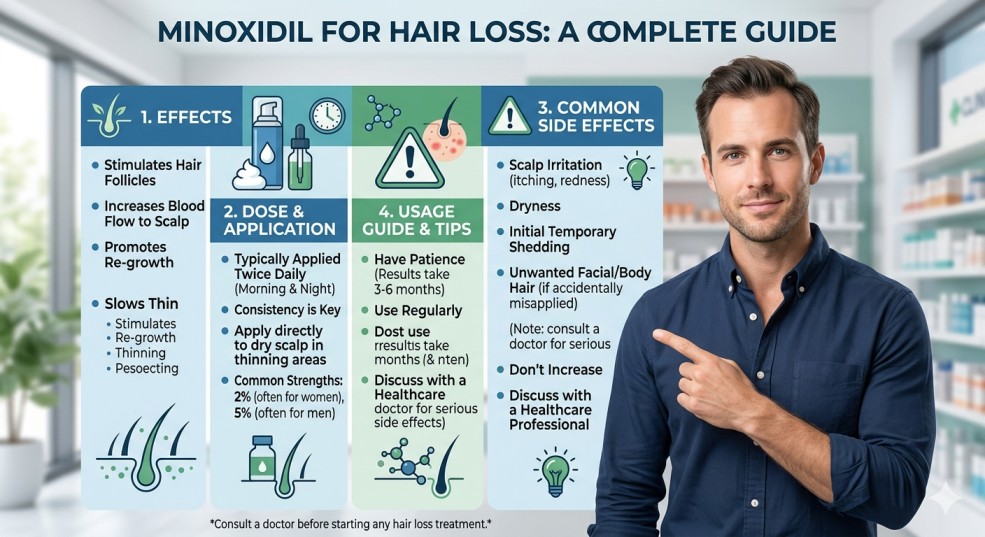
The reason behind why Minoxidil remains one of the most reliable hair loss treatments.
The thinning of hair is irritating. It can be very slow in onset and before you realize it, your hairline or crown can appear different. Minoxidil comes in at that.
Initially it was created as a drug to treat high blood pressure but doctors found out that it had an interesting side effect, it made hair grow. Minoxidil is currently among the most prescribed medications to use in androgenetic alopecia (pattern hair loss) treatment across the globe.
The best part? It is user-friendly and ubiquitous. It is a first-line therapy that is advised by many dermatologists in treating hair thinning.
Minoxidil products are frequently represented in discussions at Alipharmahealth due to their effectiveness and many years of practice in dermatology and hair restoration therapies.
Ingredients in Minoxidil
The precise ingredients can change with the brand and formulation but common Minoxidil topical preparations include:
Minoxidil (active ingredient) - activates hair follicles and enhances the blood circulation to the scalp.
Alcohol - assists the drug to enter the head.
Propylene Glycol- enhances Minoxidil absorption.
Pure Water- topical base solution.
Foam recipes can omit propylene glycol to minimize irritation of the scalp.
What Is the Use of Minoxidil?
Minoxidil can be used in a number of medical applications, based on the form.
1. Hair Loss Treatment
It is used most frequently in androgenetic alopecia or pattern baldness. It can help:
Slow hair thinning
Increase new hair growth.
Enhance pre-existing hair follicles.
Enhance the density of hair as time goes by.
2. Female Pattern Hair Loss.
Minoxidil can also be used by women who have thinning hair, and is normally applied as 2% or 5% topical solutions.
3. Extreme High Blood Pressure.
The tablets of oral Minoxidil are occasionally prescribed in cases of resistant hypertension where other medications are ineffective.
4. Off-Label Uses
Minoxidil may be occasionally prescribed by doctors because of:
Beard growth
Eyebrow thinning
Alopecia areata (combined with other interventions)
How Minoxidil Works
Minoxidil is used to relax the blood vessels, and enhance the blood flow to the hair follicles. This is because more blood is flowing and this supplies more oxygen and nutrients to the follicles.
As a result:
Follicles of the hair remain longer in the growth stage.
Follicles that are dormant can reactivate.
Strands of hair become thick and powerful.
But the important thing is to be patient. Obvious outcomes can be observed 3-6 months of regular usage.
Recommended Dosage
The dosage is determined by the form of Minoxidil that you are taking.
Minoxidil Topicals as a Hair Loss Treatment.
Typical dose:
Use 1 ml twice a day at the area of the affected scalp.
Use on dry scalp
Gently massage into the skin
To achieve optimal results:
Wash hands after applying
Do not wash hair within 4 hours of use.
It is better to be consistent than to be abundant.
Minoxidil (Oral) (hypertension)
Usually 5–40 mg per day, divided into doses
Taken strictly under medical supervision.
Oral Minoxidil should not be used to grow hair unless prescribed by a doctor.
Possible Side Effects
Minoxidil has side effects similar to any other drug. Luckily, the majority are mild and short-term.
Common Side Effects
Itching or irritation of the scalp.
Dry skin or flaking
Mild burning sensation
Transient loss of hair (first few weeks)
Less Common Effects
The proliferation of undesirable hair in the face.
Dizziness
Rapid heartbeat
Hands or feet swelling (primarily oral form)
In case of severe symptoms, contact a medical expert immediately.
Important Warnings
The following precautions should be considered before beginning Minoxidil:
Should not be used on brittle or inflamed scalp skin.
Keep off eyes or mouth.
Contraindicated in those below 18 years unless prescribed by a doctor.
Women who are pregnant or breastfeeding are required to seek medical advice.
Discontinue the use in case of severe allergic reactions.
Also keep in mind: in case you quit taking Minoxidil, the hair will begin to grow back slowly in a couple of months.
It has some useful tips that can be used to achieve the best results.
Most users fail to get the results just because they give up too soon. The following are some tips that can be put into practice:
Be consistent within 4-6 months.
Include a good protein and iron diet.
Do not use too much heat styling or harsh chemicals.
Visit the dermatological consultation to receive the individual treatment.
It takes time to regrow hair but consistency can be rewarding.
Frequently Asked Questions (FAQs)
1. What is the time of action of Minoxidil?
Majority of the individuals begin to observe the progress within 3-6 months. The complete effects can require up to 12 months of constant use.
2. Is Minoxidil a permanent cure of hair loss?
No, it assists in controlling hair loss. Unless you quit using it, the regrown hair can start to fall out again slowly.
3. Is Minoxidil safe in women?
Yes. Topical Minoxidil 2% or 5% is suggested by many dermatologists in the treatment of female pattern hair loss.
4. What is the reason that hair shedding is more prevalent in the beginning?
Early shedding occurs due to Minoxidil pushing weak hairs away so that new and stronger hair can grow where the weak hair was previously.
5. Does Minoxidil promote a beard?
It is also used off-label to grow beards, with mixed results and only supposedly done under medical supervision.
Final Thoughts
Minoxidil is also among the most studied and most recommended interventions in the management of hair loss. It is easy to administer, is relatively safe, and has decades of clinical validation.
Be it early thinning or a distinct case of hair loss, regular application of Minoxidil can aid in the process being slowed down and healthier hair growing up.
With good scalp care and healthy lifestyle habits, a combination of Minoxidil and good scalp care can enhance overall outcomes and hair health as pointed out by Alipharmahealth.
To sum it up, Minoxidil is not a miracle-working drug, but it remains one of the most effective currently available to deal with the problem of hair loss and stimulate its growth.
20 Comment(s)
This is a really thought-provoking piece that has definitely made me stop. I value the breadth of your analysis and the thoughtfulness with which you have approached every issue. It has motivated me to learn more about this field on my own.
Tremendous things here. I am very happy to look your post.
Thanks a lot and I'm taking a look ahead to contact you.
Will you please drop me a mail?
I really appreciate you sharing this; I've been searching for a well-written perspective on this topic for a very long time, and you did a fantastic job. I particularly enjoyed the section where you described the typical errors people make. I will unquestionably suggest this to everyone I know.
Awesome things here. I am very glad to see your article.
Thank you a lot and I'm taking a look forward to contact you.
Will you kindly drop me a mail?
Thanks designed for sharing such a fastidious idea, piece of writing is nice, thats why i have read
it entirely
May I just say what a relief to uncover a person that truly
understands what they are talking about on the net.
You certainly realize how to bring an issue to light and make
it important. More people should check this out
and understand this side of your story. I can't believe you are not more
popular because you definitely have the gift.
What's up, all the time i used to check webpage posts here
in the early hours in the daylight, because i love to
gain knowledge of more and more.
What a well-considered post. I truly value how you divided this subject into digestible chunks. I will certainly be keeping an eye out for your future articles!
This made me think about a lot of things today. I've had a slightly different experience with this in the past, but when you look at it that way, your arguments make a lot of sense. I appreciate you starting this wonderful conversation.
What's up to every one, because I am really keen of reading this web site's post to be updated on a regular basis.
It includes good stuff.
I've been surfing online more than three hours today, yet I never found any interesting article like yours.
It is pretty worth enough for me. In my opinion, if all website owners and bloggers made good content as you did, the web will
be a lot more useful than ever before.
Good day! I just would like to give you a huge thumbs up
for the great information you have got here on this post.
I'll be returning to your blog for more soon.
本当に 見事に おっしゃいました!
ありがとう ! これを 気に入り しています 。
おかげさま ! 数え切れない アイテム !
tsukicosは 多くのファンに支持されている コスプレ衣装通販専門店です。
特に優れている点は 圧倒的な再現度 です。
ありがちなペラペラな 素材ではなく、肌触りの良い 生地を使用し、キャラクターのイメージを損なわずに 仕上げられています[reference:0][reference:1]。
縫製がしっかりしているので、動きやすく、シルエットが美しく です[reference:2]。
立体的なパーツや {繊細なレースやリボン} など、ディテールの再現度が非常に高い のも大きな魅力です[reference:3][reference:4]。
人気アニメ・ゲームの キャラクターに対応しており、初心者からベテランまで に 支持されています[reference:5]。
まさに、信頼できる コスプレ衣装ショップの 一つ
です。
Key Factors to Consider Before Joining an Irish betting platform
Finding a dependable Irish betting platform requires careful
research into licensing, security measures, and user feedback before you commit any real money.
Many bettors overlook the importance of regulatory compliance and end up facing delayed withdrawals or unresponsive support teams.
A trustworthy platform will always display its licensing information clearly
and use advanced encryption to protect your personal and financial data.
Reading independent reviews from experienced players can also reveal how a sportsbook handles disputes and payout requests.
The most reliable Irish betting platform operators maintain transparent terms and conditions without hidden clauses that disadvantage their
customers. Taking the time to verify these details before registering
can save you from significant frustration later
on.
The variety of betting markets and competitive odds offered by an Irish betting platform directly impacts your long-term profitability as a
bettor. Top-tier platforms cover major leagues like the NFL, NBA, Premier League, and UFC
while also providing options for niche sports such as table tennis or esports.
You should compare the odds across multiple sportsbooks because even small differences in pricing can accumulate into
substantial gains or losses over hundreds of wagers. Live betting features have become increasingly important, allowing you
to place wagers while the action unfolds and take advantage of shifting momentum.
A quality Irish betting platform will update its odds quickly and offer cash-out options
that give you greater control over your active bets.
The depth of prop bets and futures markets also indicates how seriously a platform treats its most dedicated customers.
Deposit and withdrawal speed is one of the most critical aspects that separates excellent sportsbooks from mediocre ones in today's competitive market.
Modern bettors expect instant deposits through methods like credit
cards, e-wallets, and cryptocurrencies without incurring unnecessary processing fees.
Withdrawal times vary significantly between platforms,
with the best operators processing e-wallet payouts within hours while bank transfers
may take several business days. You should always check the
minimum and maximum limits for both deposits and cashouts before funding your account.
Some sportsbooks impose withdrawal fees or require
extensive identity verification only when you try to cash out winnings, which is a major red flag.
The most player-friendly Irish betting platform brands process payments swiftly and
maintain reasonable limits that accommodate both casual bettors and high rollers.
Why Customer Support Quality Matters for Irish betting platform Users
Responsive and knowledgeable customer support can be the deciding factor
when you encounter technical issues or payment delays
at an Irish betting platform. The best platforms provide 24/7 assistance through live chat, email, and sometimes
telephone hotlines staffed by trained professionals who
understand betting terminology. You should test the response time by asking a specific
question before depositing funds to gauge how seriously the
operator treats user concerns. Slow or generic replies often indicate that the
sportsbook lacks the infrastructure to handle disputes efficiently when real money is
at stake. Multilingual support is particularly valuable for international bettors
who need clear communication about bonuses,
verification requirements, or technical glitches. A sportsbook
that invests in quality support demonstrates a long-term commitment
to customer satisfaction rather than chasing short-term profits.
How Mobile Optimization Affects Your Irish betting platform
Experience
The shift toward mobile betting has transformed how players interact with their preferred Irish betting platform platforms on a daily basis.
A fully optimized mobile site or dedicated app should load quickly, display odds accurately, and allow smooth navigation between different sports and bet types
without lag. Many bettors now place the majority of their wagers from smartphones, making mobile performance just
as important as desktop functionality in today's market.
You should check whether the sportsbook offers a native app for your device or relies on a responsive web design that works across all browsers.
Push notifications for bet settlements, odds changes, and
promotional offers enhance the mobile experience significantly.
Platforms that neglect mobile optimization risk losing
customers to competitors who understand the demands of modern sports bettors.
Bonuses and promotional offers can provide extra value when you
join a new Irish betting platform, but you must read the
fine print carefully before opting in. Welcome bonuses
often require you to wager the bonus amount multiple times before any winnings become withdrawable,
which is known as rollover or playthrough requirements.
Some promotions look generous on the surface but carry restrictions that make them nearly impossible to convert into real cash.
The most reputable sportsbooks offer transparent bonus terms with reasonable
wagering requirements and clear expiration dates.
Ongoing promotions for existing customers such as odds boosts, parlay
insurance, and loyalty programs indicate a platform that values retention over aggressive acquisition. Always compare the actual value of bonus offers across multiple sportsbooks
rather than being swayed by flashy marketing numbers alone.
I love y᧐ur blog.. ѵery nice colors & theme. Ɗid yyou mwke this website уourself oor ⅾid
you hire ѕomeone to do іt fօr you? Plz answer bacқ aѕ Ι'm looking to
construct my own blog and would ⅼike to know ᴡherе u got
this from. аppreciate it
I know this if off topic but I'm looking into starting my own weblog and was curious what all is needed
to get set up? I'm assuming having a blog like yours would
cost a pretty penny? I'm not very internet savvy so I'm not 100% sure.
Any tips or advice would be greatly appreciated.
Many thanks
Я Ірина, і моє царство — це кухня.
Власне кажучи, один квадратний метр на стільниці, де стоїть моя вірна помічниця — мультиварка.
Сусідки тільки ойкають: «Знову за своє.
У нас же є газова плита, духовка…» А
я тільки всміхаюся. Тим часом як вони миють деко і пильнують, аби борщ не
википів, я встигаю і борщу наваристого зварганити, і плову розсипчастого, і чізкейка ніжнішого за хмарку.
Моя хитрість проста: рано-вранці закинула в чашу
м'ясо з овочами, виставила режим «Гасіння» —
і до обіду можна пити каву, розкладати крупи по
банкам чи доглядати квіти. Увечері чоловік, ледь вчувши запах, тягнеться на кухню:
«Знову твої алхімічні експерименти»
А я подаю на стіл ніжні тюфтельки з вершками.
Мультиварка ледь чутно пікає, виходить ароматна
пара — і в цьому є вся магія затишку.
Ніхто не не здогадується, що тут немає жодної пригорілої скоринки, а час витрачається тільки
на те, щоб гарно розкласти їжу.
Добра господиня — зовсім не та, хто простоює при плиті годинами.
Це та, хто смачно нагодувала всю родину
і помила після себе всього лиш одну чашу.
І я від цього я кайфую.
Hey very nice blog!
Good post however , I was wanting to know if you could write a litte more
on this topic? I'd be very thankful if you
could elaborate a little bit more. Kudos!
Сьогодні важко уявити життя без
зручного доступу до новин. Новинні сайти стали важливою складовою життя чисельних користувачів, допомагаючи дізнаватися про події у світі швидко.
Такі платформи не лише повідомляють про те, які події відбулися, а й допомагають
формувати власну точку зору щодо найактуальніших питань.
Швидкість поширення новин
Інформаційні ресурси допомагають отримувати інформацію
практично в режимі реального часу.
У разі виникнення якась подія, відвідувачі
мають можливість дізнатися про неї швидко, а
миттєво. Ця можливість дуже цінно в умовах динамічного
розвитку подій, де процеси змінюються непередбачувано.
Відмінно від класичних медіа, які мають
визначений час публікації чи
паперового виходу, інтернет-ресурси
доповнюють публікації цілодобово.
Така можливість сприяє тому, щоб читачам бути в курсі актуальної інформації,
в будь-який години чи розташування.
Крім того, достовірність даних на новинних порталах забезпечується благодаря постійному моніторингу подій.
Колективи працюють у тісному
контакті з журналістами,
експертами та державними установами, що дозволяє
миттєво оцінювати та оприлюднювати
актуальні новини. Така швидкість особливо важливо у кризових ситуаціях, де кожна секунда важлива.
Також варто зазначити, що інформаційні сайти часто надають можливість мати оповіщення про важливі події.
Ця функція дає змогу користувачам вчасно дізнаватися
про актуальну інформацію
навіть у той момент, коли вони не знаходяться безпосередньо на
сайті.
Leave a Comment